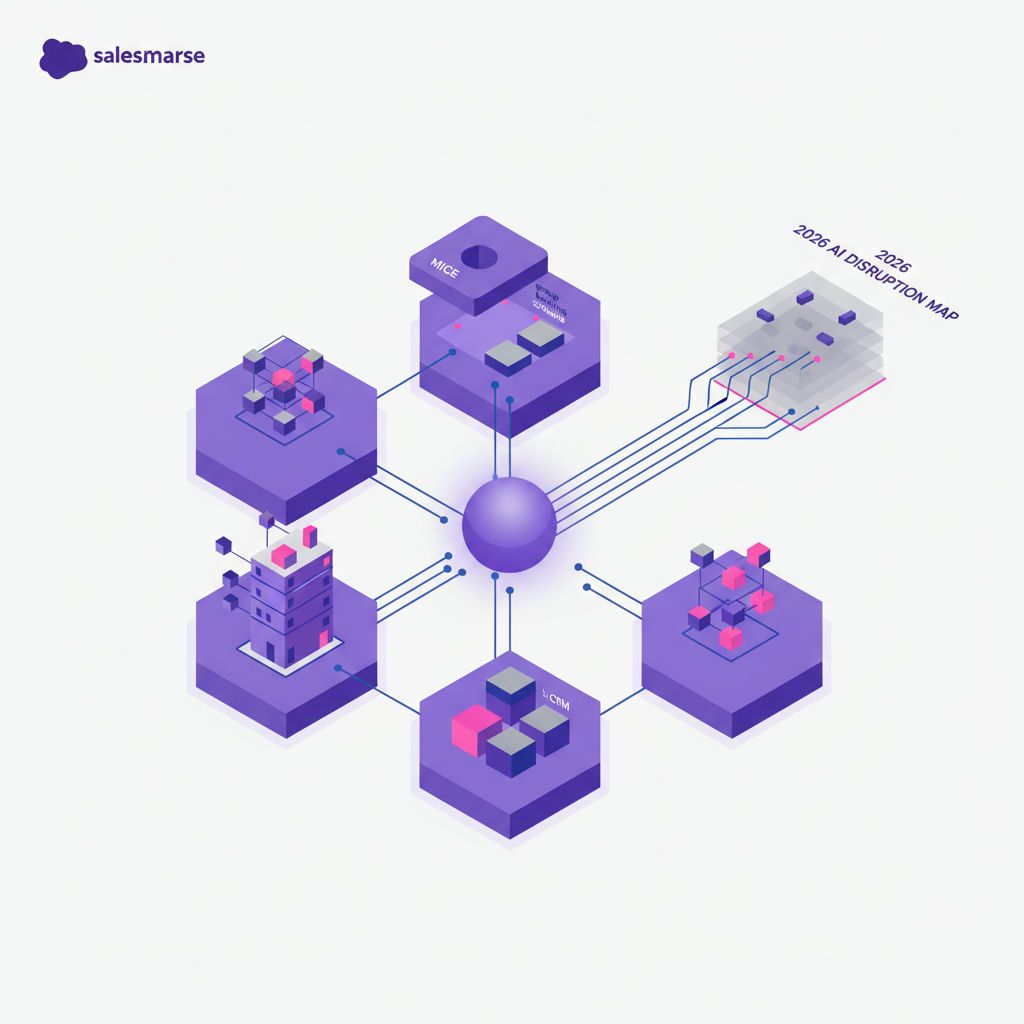
The 2026 AI Disruption Map: Where Group Sales and MICE Operations Are Being Rebuilt
Group booking software is evolving from manual RFP processing to AI-powered platforms that unify sales pipelines, multi-property inventory, and PMS-parity finance on a single CRM architecture. Properties using Salesforce-native platforms with unified data will operate at measurably higher commercial velocity than those running fragmented legacy systems—converting group business faster, forecasting with 95% accuracy, and automating 80% of guest responses while competitors manually reconcile siloed PMS, POS, and labour data.
By 2026, AI will fundamentally reshape five operational layers in hospitality: group booking workflows, CRM unification, revenue management, guest communication, and labour allocation. Properties on modern CRM infrastructure will convert group business faster, forecast with precision, and automate routine operations, while competitors remain trapped in manual reconciliation cycles.
How Group Booking Software Is Collapsing Sales Cycles From Days to Minutes
Group and MICE workflows remain the most manual, high-value processes in hospitality. A third of all room nights tie to meetings or group bookings, yet qualification, RFP interpretation, and proposal generation still consume thousands of staff hours across properties without modern group booking software.
AI-native platforms are collapsing this timeline from days to minutes by automating the entire qualification-to-proposal workflow. Thynk, built natively on Salesforce, combines AI email parsing with Agentforce agents to automate RFP triage, opportunity structuring, and proposal drafting.
Because the platform unifies group business pipelines, account hierarchies, and PMS-parity finance across properties, AI can score leads, route to the right sales office, and generate e-proposals without manual handoffs. This eliminates the fragmentation between Group CRS, inventory management, and BEO workflows—delivering single-source-of-truth group sales that scales across global sales offices.
The result: sales teams redirect hours from document assembly toward relationship-building and account expansion. Properties operating on fragmented systems continue burning staff time on manual data gathering while competitors accelerate sales velocity through unified workflows.
Why CRM Unification Determines Group Booking Performance
The most consistent disruption pattern is the collapse of siloed sales and CRM operations. Global hotel groups juggling disconnected PMS, POS, labour, and accounting platforms waste time manually stitching data together. This creates friction, erodes margins, and leaves revenue on the table.
Modern group booking software eliminates this friction by unifying operations under a single data architecture. Thynk delivers this unification natively on Salesforce—purpose-built for hospitality on the Salesforce architecture.
The platform eliminates integration debt: account hierarchies roll up automatically, group pipelines sync with multi-property inventory, and BEOs update in real time without middleware. Sales teams operate from a single B2B CRM where AI scores leads, parses emails into structured Opportunities, and distributes group business to the right properties—all within the Einstein Trust Layer for governed, secure AI.
This architectural advantage compounds daily: properties on unified platforms make faster commercial decisions, while competitors remain trapped in manual reconciliation cycles that delay every group booking decision. The gap between modern and legacy systems is structural, not incremental.
What Revenue Management Transformation Means for Group Booking
Revenue management is shifting from reactive analysis to predictive, autonomous optimization—and this transformation directly impacts group booking software performance. Extended-stay operators and luxury chains are moving beyond legacy data collaboration to adaptive AI systems that ingest multi-dimensional signals.
Thynk extends this into group and MICE revenue with AI-powered PACE/GRC reporting and ROI tracking by source, account, and segment. Because the platform integrates natively with Opera, Mews, Stayntouch, and Protel, revenue managers see pickup patterns, compression signals, and forecast variance across properties without reconciling multiple systems.
The result: faster commercial decisions grounded in unified data. Revenue managers shift from manual rate adjustments to strategic orchestration—interpreting AI recommendations and shaping commercial strategy while autonomous systems handle tactical execution.
Properties on modern platforms make decisions in hours rather than days, while competitors wait for nightly batch processes to reconcile siloed data sources. This velocity advantage translates directly to group conversion rates and portfolio-level RevPAR performance.
How Guest Communication Automation Extends Group Booking Value
Meeting planners expect instant, accurate responses across email, SMS, and portal channels. Modern group booking software automates more than 80% of routine communications in over 100 languages, solving the problem of unanswered calls and delayed responses that lose group business.
Thynk automates function sheet and BEO management as part of the group sales workflow—so operational coordination flows directly from CRM to on-property execution without manual re-entry. This eliminates the communication friction that typically occurs after contract signing.
Event details update automatically, operational teams receive structured execution data, and group coordinators track changes in real time through unified workflows. The platform embeds AI across space management, room-block management, and package management—ensuring every stakeholder operates from a single source of truth.
This seamless coordination matters for complex multi-property events: when account managers update one element, all downstream systems reflect the change instantly. Conference groups that historically required dozens of manual coordination emails now flow through automated workflows that surface only exceptions requiring human attention.
The Five Disruptions Defining Group Booking Software in 2026
Open Platforms and Salesforce-Native Architecture Won
Legacy systems that don't natively support AI integration are already falling behind. Transformation to agentic AI and agent-to-agent communication is only possible on open, API-first platforms designed for it. By 2026, properties locked into closed platforms will face migration or permanent operational disadvantage.
Thynk is built natively on Salesforce—not bolted onto it—meaning AI agents, Agentforce workflows, and Einstein Trust Layer governance are part of the core architecture, not aftermarket integrations. This eliminates the technical debt and performance lag that plague retrofitted systems.
Properties evaluating group booking software alternatives should prioritize platforms built on modern, AI-ready architectures rather than legacy systems promising future integration. The infrastructure gap compounds daily, with modern systems processing group RFPs in minutes while legacy platforms require hours or days.
Data Unification Is Infrastructure, Not Optional
AI is only as valuable as the data it can access. Fragmented systems produce fragmented intelligence. Winners in 2026 will have unified PMS, POS, labour, CRM, revenue management, and operations into a single source of truth.
Thynk delivers this through Salesforce's single-source-of-truth model: account hierarchies roll up automatically, group pipelines sync with multi-property inventory, finance data maintains PMS parity, and BEOs update in real time. This isn't integration—it's native unification.
Properties operating on fragmented systems face compounding disadvantages:
- Slower decision cycles from manual data gathering across systems
- Higher reconciliation overhead consuming staff hours daily
- Delayed responses to group RFPs while competitors respond instantly
- Revenue leakage from data silos hiding pickup patterns
The velocity advantage of unified platforms becomes visible within weeks of deployment. Sales teams spend time selling instead of reconciling spreadsheets, while revenue managers make pricing decisions based on real-time data rather than yesterday's batch reports.
Revenue Managers Elevate to Strategic Orchestrators
AI is transforming revenue management from manual analysis to autonomous optimization. The role isn't disappearing—it's elevating. Revenue managers will shift from tactical execution (adjusting rates, building forecasts) to strategic orchestration (interpreting AI recommendations, shaping commercial strategy).
Thynk accelerates this shift by embedding AI into group sales scoring, multi-property e-proposal generation, and room-block pickup—allowing revenue managers to focus on portfolio strategy rather than manual RFP responses. The platform's GSO capabilities enable portfolio-level decision-making.
This transformation directly impacts group booking performance: properties where revenue managers operate strategically will outperform competitors trapped in tactical cycles. Modern platforms surface strategic questions (Which accounts should we prioritize for 2027?) rather than tactical ones (What rate did we quote this group last year?).
Guest Communication Becomes the Loyalty Battleground
When AI unifies public knowledge (reviews, descriptions) with private knowledge (preferences, history), communication stops being fragmented and becomes continuous. For group business, this matters: meeting planners expect instant, accurate responses across every channel they choose to engage.
Group booking software that unifies communication workflows converts faster than systems requiring manual channel-switching. The hotel that masters this becomes invisible in the best way: planners never navigate channels or repeat themselves. The hotel that doesn't will feel clunky compared to competitors operating at conversational speed.
Thynk's Salesforce-native architecture means communication history, negotiation context, and event requirements exist in one system. When a planner emails Monday, calls Tuesday, and texts Wednesday, the sales manager sees the complete conversation thread—not three disconnected interactions requiring manual correlation.
2026 Separates the Prepared from the Stranded
AI adoption in hospitality is creating a two-speed industry. Properties that have invested in modern infrastructure, unified data, and AI-ready platforms will operate with advantages that compound daily: better pricing decisions, leaner operations, more personalized service, higher direct conversion.
Properties running on legacy systems, fragmented data, and manual workflows will fall further behind each quarter. The gap is structural, not incremental—and by late 2026, it will be visible in RevPAR, guest satisfaction, labour efficiency, and profit margins.
For group booking operations specifically: properties on modern platforms will convert RFPs in hours rather than days, forecast group pickup with precision rather than guesswork, and coordinate multi-property events without manual reconciliation. The velocity advantage translates directly to market share and revenue growth.
What Group Booking Software Should Deliver in 2026
Modern group booking software must deliver five core capabilities to compete in the 2026 landscape:
Unified CRM Architecture
Account hierarchies, group pipelines, and multi-property inventory must exist in a single platform—not stitched together through middleware integrations. This eliminates manual reconciliation and enables AI to operate across the entire sales workflow.
AI-Powered RFP Automation
Email parsing, lead scoring, opportunity structuring, and proposal generation should operate autonomously—collapsing sales cycles from days to minutes and redirecting staff time toward relationship-building.
PMS-Parity Finance
Real-time synchronization with Opera, Mews, Stayntouch, and Protel ensures revenue managers and sales teams operate from the same data source—eliminating forecast variance and pickup disputes.
BEO and Function Sheet Automation
Event execution details should flow directly from CRM to operations without manual re-entry—ensuring on-property teams receive accurate, structured information in real time.
Governed AI with Enterprise Security
Einstein Trust Layer or equivalent governance frameworks ensure AI operates within compliance, security, and auditability requirements—critical for enterprise hospitality operations handling sensitive account data.
Learn more about how to evaluate group booking platforms or explore Salesforce-native capabilities that enable unified operations.
How Thynk Delivers the 2026 Group Booking Standard
Thynk is purpose-built for the 2026 reality these disruptions describe:
Salesforce-Native Architecture
Built on Salesforce, not bolted onto it—Agentforce agents operate autonomously across group sales, CRM, and BEO workflows without integration lag or technical debt.
Unified Data Fabric
Single-source-of-truth performance: account hierarchies, group pipelines, PMS-parity finance, and multi-property inventory exist in one platform, eliminating reconciliation overhead.
AI-Powered Sales Automation
Email parsing, RFP triage, lead scoring, proposal generation, and pickup tracking collapse group sales cycles from days to minutes—accelerating revenue velocity and conversion rates.
Native PMS Integrations
Real-time data sync with Opera, Mews, Stayntouch, and Protel ensures revenue managers and sales teams operate from unified data without middleware delay.
Einstein Trust Layer Governance
Enterprise-grade security, compliance, and auditability for AI operations—critical for group sales and MICE workflows handling sensitive account data.
Multi-Property Coordination
Global sales office workflows, portfolio-level account management, and automated RFP distribution ensure group business flows to the right properties without manual routing.
Operational Excellence
Function sheets, BEOs, and event coordination sync automatically from CRM to on-property execution—eliminating manual handoffs and ensuring operational teams receive accurate event data.
The Bottom Line: Infrastructure Determines Group Booking Performance
The 2026 AI disruption map is drawn. Properties winning on group conversion, revenue velocity, and profitability will be those running on Salesforce-native, AI-first platforms built for unified data and autonomous workflows.
The question isn't whether AI will transform hotels—the infrastructure is already being deployed. The question is whether your property will operate on the systems that make that transformation possible, or watch competitors pull ahead while you're still reconciling siloed PMS data.
The choice is structural: modern platforms like Thynk that unify CRM, group sales, MICE, and operations under a single AI-governed architecture—or legacy systems patching together fixes while the market moves faster than they can integrate. For group booking software specifically, this means properties on unified platforms will convert faster, forecast with precision, and coordinate seamlessly across properties—while competitors burn staff hours on manual workflows.
The 2026 advantage isn't incremental. It's architectural. And it compounds daily.